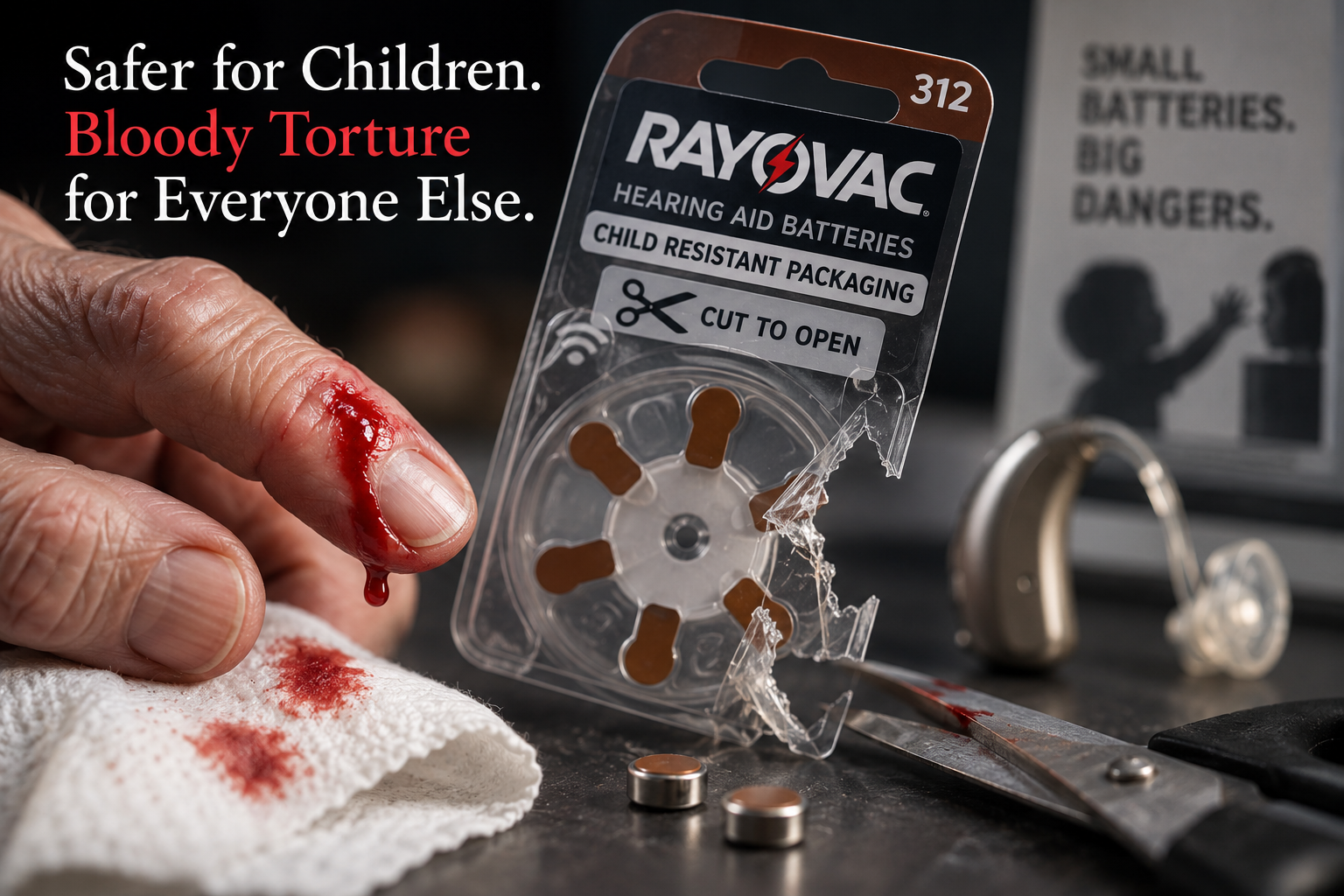
Safer for Children. Bloody Torture for Everyone Else.
A child-resistant packaging standard excludes the disabled from its senior test panels, producing hearing aid batteries that require cutlery and routinely cut their owners.
There is a particular genre of administrative elegance in which every participant follows the regulations to the letter and the final output is completely unusable by the people it was built for. The latest triumph of this craft involves zinc-air hearing aid batteries.
According to regulatory filings under Reese's Law, Congress mandated child-resistant packaging for button and coin cells to prevent catastrophic ingestion injuries in infants. This is an indisputably vital goal: the Consumer Product Safety Commission (CPSC) recorded 27 deaths and more than 54,000 emergency department visits linked to button-battery ingestions between 2011 and 2021. However, the CPSC subsequently determined that zinc-air batteries—the kind that power hearing aids—rely on ambient oxygen to produce voltage and do not present the severe chemical burn hazard of other button chemistries, explicitly carving them out of appliance compartment rules. Yet, the statutory packaging mandate swept them in regardless.
To ensure that child-resistant packaging does not permanently barricade adults, 16 CFR § 1700.15 requires packages to achieve a 90% 'senior-adult use effectiveness' rate. On paper, this is compassionate governance. In the federal register, however, the CPSC's definition of a 'senior' under 16 CFR § 1700.20 is capped at age 70, while strictly barring anyone with a temporary or permanent illness, injury, or disability that might impair their dexterity.
The resulting product—such as Rayovac's Size 312 models—passes the regulatory test with flying colors. Rayovac's published technical documentation indicates a 98% opening rate among tested panel members. The trade-off is printed directly on the front of the blister pack: a pair of scissors, accompanied by instructions to 'Cut to Open.'
The physical consequence of forcing elderly consumers to wield kitchen shears against hardened polymer is entirely predictable. As reported by The Chronicle, audiologist Dr. Colette Vossler-Welch noted that multiple patients at her clinic have cut themselves attempting to open the new child-resistant packs, with some accidentally cutting directly into the tiny cells and ruining their hearing aids. Across customer review boards on Target, Walmart, and manufacturer portals, users routinely report bleeding fingers, sliced palms, and ruined scissors from prying open the serrated plastic remnants. Secondary incident summaries from Farzan Law reflect identical injuries logged against Energizer and Member's Mark packaging, while a 2025 Forbes analysis of over 3,500 battery complaints noted that roughly a tenth involved physical distress or injury. Even industry evaluators at Hearing Tracker have begun steering older buyers toward rechargeable aids specifically to avoid 'impossible to open battery packages.'
As reflected in retail reviews and FDA MAUDE incident reports, real-world hearing aid users are frequently older than 70 and disproportionately affected by arthritis. When hearing aid batteries expire away from home, users without shears or kitchen knives are left functionally deafened by design, all to protect infants from a chemical hazard that regulators already acknowledged zinc-air cells do not produce.
Evidence & source material
- DOCUMENT
Instagram
Attached from The Wire. Sourcing must be verified before publication.
Response from the responsible party
No response received. The right of reply remains open indefinitely and any statement will be published here in full, unedited.
Case updates
CASE OPENED
Published after editorial verification.
Reader assessment
Tick everything that applies. Reader votes are advisory: they inform the frequency factor; they do not set the score.